Inca Trail Difficulty: How Hard Is the Inca Trail?
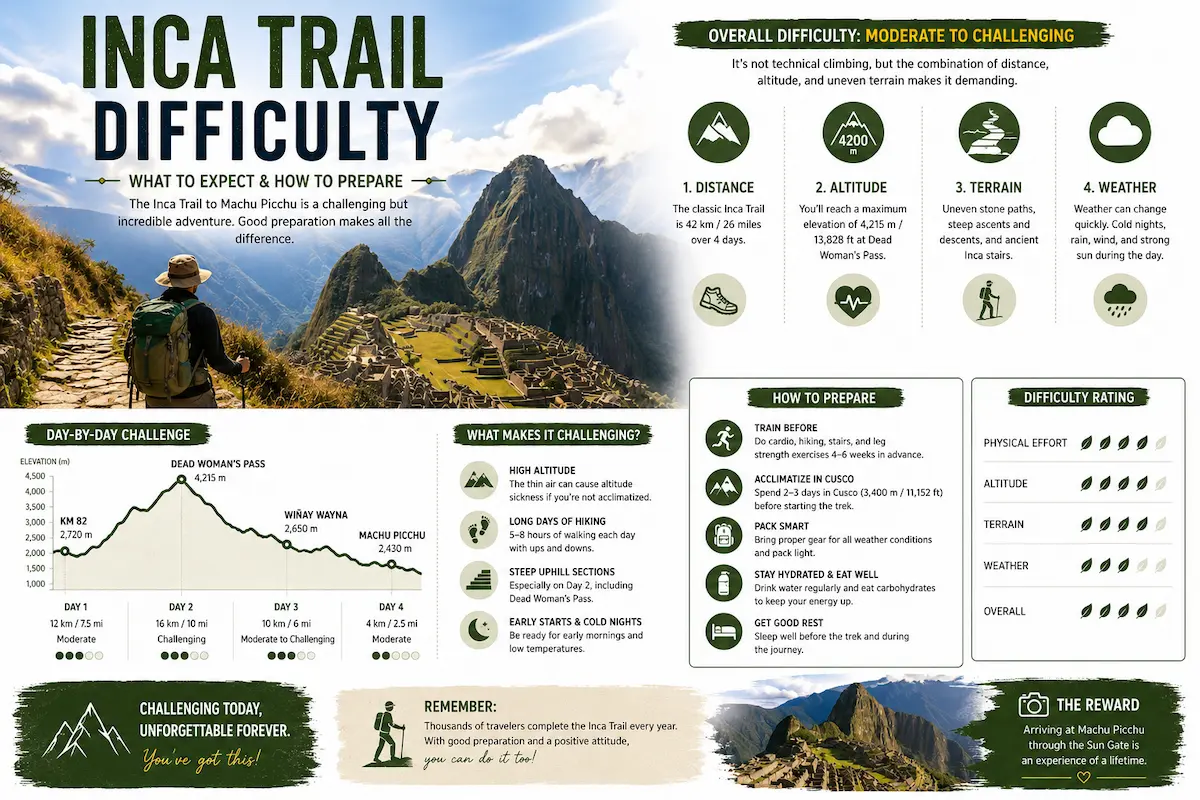
The Inca Trail is a moderate to challenging high-altitude trek. You do not need technical climbing skills, but you should be prepared for steep stone steps, long ascents, high elevation, changing weather, and several consecutive days of hiking.
For most travelers, altitude and the repeated climbs and descents are harder than the total distance.
The Classic Inca Trail normally takes four days and reaches its highest point at Dead Woman’s Pass, approximately 4,215 meters (13,829 ft) above sea level.
If you have a reasonable fitness level, train before your trip, and spend enough time acclimatizing in Cusco, the trek is achievable for many active travelers.
Table Of Content
- 1 How Difficult Is the Inca Trail?
- 2 What Makes the Inca Trail Difficult?
- 3 What Is the Hardest Day of the Inca Trail?
- 4 How Hard Is Dead Woman’s Pass?
- 5 How Long Is the Inca Trail?
- 6 How Much Elevation Does the Inca Trail Have?
- 7 Do You Need to Be Fit for the Inca Trail?
- 8 How Should You Train for the Inca Trail?
- 9 How Much Does Altitude Affect the Difficulty?
- 10 How Many Days Should You Acclimatize Before the Inca Trail?
- 11 Is the Inca Trail Harder Than the Salkantay Trek?
- 12 Is the Short Inca Trail Easier?
- 13 Can Beginners Hike the Inca Trail?
- 14 What Should You Carry While Hiking?
- 15 Are the Inca Trail Descents Difficult?
- 16 Can Older Travelers Complete the Inca Trail?
- 17 How to Make the Inca Trail Easier
- 18 Inca Trail Difficulty vs Other Treks
- 19 Is the Inca Trail Worth the Difficulty?
- 20 Frequently Asked Questions
- 20.1 Is the Inca Trail difficult?
- 20.2 What is the hardest part of the Inca Trail?
- 20.3 Do you need to be an experienced hiker?
- 20.4 Can I hike the Inca Trail if I am afraid of heights?
- 20.5 Is the Inca Trail harder because of altitude?
- 20.6 How fit should I be?
- 20.7 Is Day 2 the hardest day?
- 20.8 Is the Short Inca Trail difficult?
How Difficult Is the Inca Trail?
We would rate the Classic Inca Trail as moderate to challenging.
| Factor | Difficulty |
|---|---|
| Overall difficulty | Moderate to challenging |
| Altitude | Challenging |
| Distance | Moderate |
| Steep climbs | Challenging |
| Descents | Moderate to challenging |
| Terrain | Uneven |
| Technical climbing | Not required |
| Consecutive hiking days | 4 days |
| Highest point | Approx. 4,215 m / 13,829 ft |
The trail is not technically difficult. You do not need ropes, climbing equipment, or mountaineering experience.
The challenge comes from combining altitude, elevation changes, stone staircases, long hiking days, and limited recovery time between each day.
If you want to understand the complete route before deciding whether it is suitable for you, read our Inca Trail to Machu Picchu guide.
What Makes the Inca Trail Difficult?
Several factors determine how hard the trek feels.
1. High Altitude
Altitude is one of the biggest challenges.
The trek begins below the elevation of its highest mountain passes, but you gradually climb into high-altitude terrain.
The highest point is Dead Woman’s Pass at approximately 4,215 meters (13,829 ft).
At this elevation, the air contains less oxygen than at sea level. You may notice that your breathing becomes faster and that climbing requires more effort.
Even travelers who exercise regularly can find high-altitude hiking demanding.
Our Inca Trail altitude guide explains the elevations along the route and how to prepare before the trek.
2. Dead Woman’s Pass
Dead Woman’s Pass, or Warmiwañusca, is generally considered one of the hardest sections of the Classic Inca Trail.
The difficulty comes from the long climb combined with altitude.
You need to maintain a steady pace rather than trying to climb quickly.
The pass itself sits at approximately 4,215 meters, making it the highest point of the traditional route.
You can learn more about the ascent, elevation, and trail conditions in our guide to Dead Woman’s Pass.
3. Inca Stone Steps
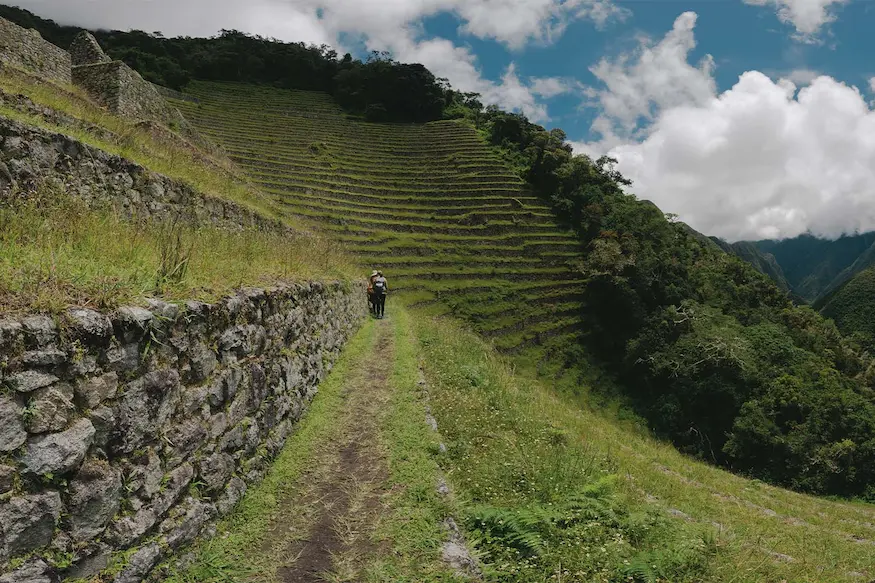
The Inca Trail contains many stone staircases.
Some climb steeply. Others descend for long sections.
Descending can be particularly tiring because repeated steps place pressure on your knees and legs.
This is one reason why simply training on flat roads is not enough preparation.
Include hills and stairs in your training whenever possible.
4. Consecutive Days of Hiking
One difficult hiking day is very different from hiking several days in a row.
On the Classic route, your legs have limited time to recover before you begin walking again the next morning.
Fatigue can accumulate throughout the trek.
This is why preparation should include longer walks rather than only short workouts.
Our Inca Trail training guide explains how to prepare for consecutive hiking days.
5. Changing Weather
Weather can make the same section of trail feel completely different.
Rain may make stone sections wet and slippery. Strong sun can make exposed climbs feel more tiring. Cold temperatures are also possible at higher elevations and during the night.
Conditions depend heavily on the season.
Check our Inca Trail weather guide and the best time to hike the Inca Trail before choosing your travel dates.
What Is the Hardest Day of the Inca Trail?
For many hikers, Day 2 is the most physically demanding day of the Classic Inca Trail.
This is the day associated with the climb toward Dead Woman’s Pass.
The ascent is long and becomes progressively more demanding as you gain elevation.
Your pace will usually become slower near the top.
Do not compare your speed with other hikers. Walking slowly and consistently is more useful than starting quickly and becoming exhausted before reaching the pass.
The exact daily itinerary can vary according to the trekking program and campsite arrangements.
How Hard Is Dead Woman’s Pass?
Dead Woman’s Pass is challenging primarily because of its altitude and sustained ascent.
At approximately 4,215 meters, even simple movement requires more effort than it would at lower elevations.
You may need frequent short breaks during the final part of the climb.
The important thing is not speed.
A steady pace, controlled breathing, hydration, and proper acclimatization can make a major difference.
How Long Is the Inca Trail?
The Classic Inca Trail is commonly described as being approximately 42 km (26 miles) long.
That number alone can make the trek seem easier than it actually is.
The difficulty comes from the terrain.
Walking 10 kilometers on a flat road is very different from covering the same distance while climbing stone staircases at high altitude.
For daily distances and a better understanding of the route, see our Inca Trail distance guide.
How Much Elevation Does the Inca Trail Have?
The Classic route includes repeated climbs and descents rather than one continuous ascent.
You pass through different ecological zones and elevations before reaching Machu Picchu.
The highest point is:
Dead Woman’s Pass: approximately 4,215 m / 13,829 ft
Machu Picchu itself sits considerably lower, at around 2,430 m / 7,972 ft.
This variation in elevation is one reason the trek can feel physically demanding.
Do You Need to Be Fit for the Inca Trail?
You should have a reasonable level of fitness, but you do not need to be an athlete.
You will benefit from being comfortable with:
Walking several hours
Hiking uphill
Hiking downhill
Climbing stairs
Carrying a small daypack
Exercising on consecutive days
Someone who regularly walks, hikes, runs, cycles, or exercises will usually have an easier preparation period than someone who is mostly inactive.
However, fitness and acclimatization are different.
A very fit traveler can still struggle with altitude.
How Should You Train for the Inca Trail?
Training should focus on endurance and leg strength.
Start several weeks before your trip when possible.
Useful preparation includes:
Walking longer distances
Hiking hills
Stair climbing
Squats and lunges
Cardiovascular exercise
Hiking with a small backpack
Consecutive walking days
Gradually increase your training instead of suddenly completing very long hikes.
You do not need to recreate the exact conditions of the Andes. The goal is to make your body comfortable with sustained physical activity.
How Much Does Altitude Affect the Difficulty?
Altitude can significantly change how difficult the trek feels.
You may walk comfortably at home but become tired much faster above 3,000 or 4,000 meters.
Possible effects of altitude include headache, fatigue, reduced appetite, dizziness, nausea, and shortness of breath.
This is why you should not arrive in Cusco and immediately begin a demanding high-altitude trek.
Spend time acclimatizing before departure.
If you are organizing the entire trip yourself, our guide on how to plan the Inca Trail to Machu Picchu explains where acclimatization should fit into your itinerary.
How Many Days Should You Acclimatize Before the Inca Trail?
Many travelers spend at least two or three days in Cusco or the Sacred Valley before beginning the trek.
There is no exact acclimatization period that works for everyone.
Your previous altitude exposure, individual response, itinerary, and general condition all matter.
Use your first days to rest, hydrate, eat properly, and gradually become accustomed to the elevation.
Do not fill every acclimatization day with demanding hikes.
Is the Inca Trail Harder Than the Salkantay Trek?
They are difficult in different ways.
| Factor | Inca Trail | Salkantay Trek |
|---|---|---|
| Typical duration | 4 days | Around 5 days |
| Highest elevation | ~4,215 m | ~4,630 m |
| Stone steps | Many | Fewer |
| Archaeological sites | Numerous | Fewer |
| Highest altitude | Lower | Higher |
| Permit restrictions | Strict | Different access system |
| Technical climbing | No | No |
Salkantay reaches a higher elevation, while the Inca Trail contains more stone staircases and repeated archaeological sections.
Which feels harder depends on your fitness, altitude tolerance, weather, and itinerary.
For a complete comparison, read Inca Trail vs Salkantay Trek.
Is the Short Inca Trail Easier?
Yes, the Short Inca Trail is generally easier than the four-day Classic route.
You avoid several of the highest mountain passes and do not complete four consecutive days of trekking.
However, the Short Inca Trail still includes uphill hiking and stone steps.
It should not be considered an effortless walk.
If you are deciding between both routes, see our Short Inca Trail vs Classic Inca Trail comparison.
Can Beginners Hike the Inca Trail?
Yes, beginners can complete the Inca Trail if they prepare properly.
Previous multi-day trekking experience helps, but it is not mandatory.
A beginner should pay particular attention to:
Physical preparation
Acclimatization
Hiking footwear
Packing light
Weather protection
Hydration
Pacing
Your first multi-day trek should not also be your first experience walking uphill for several hours.
Complete some training hikes before traveling to Peru.
What Should You Carry While Hiking?
Keep your daypack as light as possible.
Typical items include:
Water
Rain jacket
Sun protection
Personal medication
Snacks
Camera or phone
Extra layer
Hat
Sunglasses
Carrying unnecessary weight makes climbs harder.
Use our complete Inca Trail packing list to decide what you actually need and what you can leave behind.
Are the Inca Trail Descents Difficult?
They can be.
Travelers often focus on Dead Woman’s Pass and forget about the downhill sections.
Long stone staircases can become tiring and place considerable pressure on your knees.
Take your time when descending, especially when the stones are wet.
Trekking poles can also provide additional stability where their use is permitted and appropriate.
Can Older Travelers Complete the Inca Trail?
Age alone does not determine whether someone can complete the trek.
Fitness, mobility, altitude response, previous hiking experience, and medical considerations are more important.
Active older travelers regularly complete high-altitude treks, while younger travelers who arrive without preparation may struggle.
Anyone with concerns about exercising at high altitude should discuss their travel plans with an appropriate healthcare professional before the trip.
How to Make the Inca Trail Easier
You cannot remove the mountain passes or stone steps, but good preparation can make the experience much more manageable.
Focus on these points:
Spend enough time acclimatizing.
Train before traveling.
Pack light.
Wear comfortable hiking footwear.
Maintain a steady pace.
Drink water regularly.
Eat enough during the trek.
Prepare for rain and cold.
Rest properly at camp.
Do not rush the climbs.
Preparation matters more than speed.
Inca Trail Difficulty vs Other Treks
If you are still choosing a trek to Machu Picchu, difficulty should be only one part of your decision.
The Inca Trail combines physical challenge with archaeological sites, original stone pathways, mountain scenery, cloud forest, and a distinctive approach toward Machu Picchu.
Alternative routes may reach higher elevations, cover different terrain, or offer more flexibility.
Compare the Inca Trail vs Salkantay Trek, Inca Trail vs Lares Trek, and Inca Trail vs Ausangate Trek before deciding which experience fits your travel style and physical condition.
Is the Inca Trail Worth the Difficulty?
For many travelers, yes.
The physical challenge is part of the experience, but the route is not only about hiking.
You pass archaeological sites, mountain passes, valleys, cloud forest, and original Inca pathways before reaching the Machu Picchu area.
If you arrive acclimatized and physically prepared, you can focus more on the landscape and history instead of simply trying to finish each day.
Read Is the Inca Trail Worth It? if you are still deciding whether this trek is right for you.
Frequently Asked Questions
Is the Inca Trail difficult?
The Classic Inca Trail is considered moderate to challenging. The main difficulties are altitude, steep climbs, stone staircases, descents, and four consecutive days of hiking.
What is the hardest part of the Inca Trail?
The climb to Dead Woman’s Pass is commonly considered one of the hardest sections because it reaches approximately 4,215 meters above sea level.
Do you need to be an experienced hiker?
No. Previous hiking experience is helpful, but beginners with good preparation and reasonable fitness can complete the trek.
Can I hike the Inca Trail if I am afraid of heights?
The route crosses mountainous terrain and includes steep sections. If you have a strong fear of heights, discuss the route with your trekking operator before booking so you understand the terrain you will encounter.
Is the Inca Trail harder because of altitude?
Yes. Altitude reduces the amount of oxygen available to your body and can make climbing considerably more tiring.
How fit should I be?
You should be comfortable walking for several hours, climbing hills or stairs, and repeating physical activity on consecutive days.
Is Day 2 the hardest day?
For many hikers, yes. It normally includes the demanding ascent toward Dead Woman’s Pass, although the exact experience depends on your itinerary and personal fitness.
Is the Short Inca Trail difficult?
The Short Inca Trail still requires uphill walking and climbing stone steps, but it is generally less physically demanding than the four-day Classic Inca Trail.