
Inca Trail Altitude: Elevation, Highest Point and Acclimatization
Hiking the Inca Trail in January is possible but it comes with important considerations. January falls in the middle of the rainy season in Peru, which means fewer crowds but also challenging weather conditions.
If you’re planning to trek to Machu Picchu during this time, here’s everything you need to know before booking.
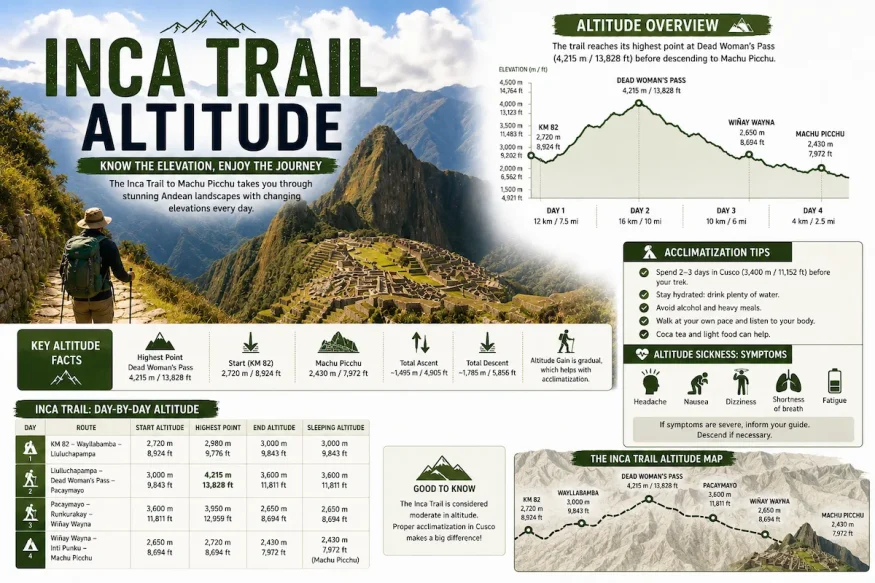
Table Of Content
- 1 How High Is the Inca Trail?
- 2 What Is the Highest Point on the Inca Trail?
- 3 Inca Trail Elevation Profile
- 4 Why Does Altitude Make the Inca Trail Harder?
- 5 What Is the Altitude at the Start of the Inca Trail?
- 6 Is Cusco Higher Than the Start of the Inca Trail?
- 7 Is Machu Picchu Higher Than Cusco?
- 8 Inca Trail Altitude by Day
- 9 What Is Dead Woman’s Pass Altitude?
- 10 Can You Get Altitude Sickness on the Inca Trail?
- 11 How Many Days Should You Acclimatize Before the Inca Trail?
- 12 Cusco or Sacred Valley for Acclimatization?
- 13 Does Being Fit Prevent Altitude Sickness?
- 14 How to Handle the Altitude on the Inca Trail
- 15 Does Altitude Change With the Season?
- 16 What Should You Pack for High Altitude?
- 17 Is the Short Inca Trail as High as the Classic Inca Trail?
- 18 Inca Trail vs Salkantay Altitude
- 19 Is Inca Trail Altitude Dangerous?
- 20 Frequently Asked Questions
- 20.1 What is the highest altitude on the Inca Trail?
- 20.2 Is the Inca Trail higher than Cusco?
- 20.3 Is Machu Picchu higher than Cusco?
- 20.4 Can you get altitude sickness on the Inca Trail?
- 20.5 How long should I acclimatize before the Inca Trail?
- 20.6 What is Dead Woman’s Pass elevation?
- 20.7 Is the Short Inca Trail better for altitude?
- 21 Prepare for the Inca Trail Altitude
The Inca Trail reaches elevations above 4,000 meters, making altitude one of the most important factors to consider before hiking to Machu Picchu.
The highest point on the Classic Inca Trail is Dead Woman’s Pass, or Warmiwañusca, at approximately 4,215 meters (13,829 ft) above sea level.
However, the challenge is not limited to one mountain pass. During the trek, you repeatedly climb and descend through different elevations before reaching Machu Picchu.
Understanding the altitude profile will help you prepare, acclimatize in Cusco, and know what to expect during the hardest sections of the trail.
How High Is the Inca Trail?
The Classic Inca Trail passes through elevations ranging from approximately 2,400 meters to more than 4,200 meters above sea level.
Here is a simple overview:
| Location | Approx. Altitude |
|---|---|
| Km 82 / Piskacucho | 2,700 m / 8,858 ft |
| Wayllabamba | 3,000 m / 9,843 ft |
| Llulluchapampa | 3,800 m / 12,467 ft |
| Dead Woman’s Pass | 4,215 m / 13,829 ft |
| Pacaymayo | 3,600 m / 11,811 ft |
| Runkurakay Pass | 3,950 m / 12,959 ft |
| Phuyupatamarca | 3,650 m / 11,975 ft |
| Wiñay Wayna | 2,650 m / 8,694 ft |
| Machu Picchu | 2,430 m / 7,972 ft |
These elevations are approximate and can vary slightly depending on the specific point used for measurement.
The important part is the overall profile: you climb high and then descend significantly before reaching Machu Picchu.
If you want to understand how altitude combines with stairs, distance, and consecutive hiking days, read our complete guide to Inca Trail difficulty.
What Is the Highest Point on the Inca Trail?
The highest point of the Classic Inca Trail is Dead Woman’s Pass.
It reaches approximately:
4,215 m / 13,829 ft
The Quechua name for the pass is Warmiwañusca.
Reaching the pass is one of the major physical challenges of the trek because you gain considerable elevation during the ascent.
The higher you climb, the more noticeable the reduced oxygen can become.
You may find yourself walking more slowly and stopping more frequently than you normally would at lower elevations.
Read our complete guide to Dead Woman’s Pass to see what the climb is like and how to prepare for this section.
Inca Trail Elevation Profile
The Inca Trail does not simply climb to its highest point and descend directly to Machu Picchu.
Its elevation profile includes several major ascents and descents.
A simplified profile looks like this:
Km 82
2,700 m
↓
Wayllabamba
3,000 m
↑
Llulluchapampa
3,800 m
↑
Dead Woman’s Pass
4,215 m
↓
Pacaymayo
3,600 m
↑
Runkurakay Pass
3,950 m
↓
Phuyupatamarca
3,650 m
↓
Wiñay Wayna
2,650 m
↓
Machu Picchu
2,430 m
This repeated elevation change is one reason the Classic Inca Trail can feel harder than its total distance suggests.
Why Does Altitude Make the Inca Trail Harder?
At higher elevations, atmospheric pressure decreases, so less oxygen is available with each breath.
Your body has to work harder during physical activity.
You may notice:
Faster breathing
Increased heart rate
Greater fatigue
Slower hiking pace
Shortness of breath during climbs
Longer recovery after steep sections
This does not automatically mean something is wrong.
Walking uphill at 4,000 meters will normally feel different from hiking at sea level.
The key is allowing your body time to adjust before beginning the trek.
What Is the Altitude at the Start of the Inca Trail?
The traditional Classic Inca Trail commonly begins around Km 82 near Piskacucho, at approximately 2,700 meters (8,858 ft).
From here, the route gradually gains elevation.
This means you do not begin immediately at 4,000 meters.
The first sections allow you to experience the landscape before the major climb toward the highest passes.
However, you should already be acclimatized before arriving at the trailhead.
Is Cusco Higher Than the Start of the Inca Trail?
Yes.
Cusco sits at approximately 3,400 meters (11,152 ft) above sea level, while the traditional starting area of the Classic Inca Trail is lower.
This can actually help with preparation.
If you spend several days in Cusco before the trek, your body begins adapting to an elevation higher than the starting point of the trail.
However, Dead Woman’s Pass is still roughly 800 meters higher than Cusco.
That difference becomes noticeable during the climb.
Is Machu Picchu Higher Than Cusco?
No.
Machu Picchu sits at approximately 2,430 meters (7,972 ft) above sea level.
Cusco is around 3,400 meters (11,152 ft).
This means Machu Picchu is almost 1,000 meters lower than Cusco.
Travelers sometimes assume Machu Picchu is the highest point of the trip because it is surrounded by dramatic mountains.
It is actually much lower than several sections of the Inca Trail.
Inca Trail Altitude by Day
The exact itinerary and campsites can vary, but the Classic Inca Trail is usually completed over four days.
Day 1: Gradual Altitude Gain
The first day normally begins near Km 82.
The elevation is relatively moderate compared with the following day.
You gradually enter the mountains and begin gaining altitude.
For many hikers, Day 1 provides an opportunity to settle into a comfortable walking pace.
Do not make the mistake of hiking too quickly simply because you feel strong.
Save energy for the higher sections ahead.
Day 2: Highest Altitude
Day 2 is usually the most demanding day for altitude.
This is when hikers climb toward Dead Woman’s Pass at approximately 4,215 meters.
The combination of steep climbing and reduced oxygen makes this section challenging.
Walk slowly.
Take short breaks when necessary.
You do not need to reach the pass quickly.
Day 3: More Passes and Major Descents
After crossing the highest point, the trek is not suddenly easy.
You continue through mountainous terrain and cross additional elevated sections.
Runkurakay Pass reaches approximately 3,950 meters.
The route then begins a longer transition toward lower elevations.
Long descents can be tiring, especially on stone steps.
Day 4: Lower Elevation Toward Machu Picchu
By the final section, you are considerably lower than at Dead Woman’s Pass.
The trail passes through greener and more humid environments as you approach Machu Picchu.
This change in altitude is one of the reasons the landscape varies so much along the route.
What Is Dead Woman’s Pass Altitude?
Dead Woman’s Pass sits at approximately:
4,215 meters
or
13,829 feet
It is the highest point on the standard Classic Inca Trail.
For comparison:
| Place | Approx. Altitude |
|---|---|
| Machu Picchu | 2,430 m |
| Km 82 | 2,700 m |
| Cusco | 3,400 m |
| Runkurakay Pass | 3,950 m |
| Dead Woman’s Pass | 4,215 m |
This makes the difference between Machu Picchu and the highest point of the trek approximately 1,785 meters.
Can You Get Altitude Sickness on the Inca Trail?
Yes.
Altitude sickness can affect travelers on the Inca Trail because significant sections of the route are above 3,000 meters.
Being young or physically fit does not guarantee that you will avoid altitude problems.
Common mild symptoms can include:
Headache
Fatigue
Dizziness
Reduced appetite
Nausea
Difficulty sleeping
Shortness of breath during activity
Symptoms should not simply be ignored if they become severe or continue getting worse.
Your guide should know if you are feeling unwell during the trek.
How Many Days Should You Acclimatize Before the Inca Trail?
Many travelers plan at least two or three days at altitude before beginning the Classic Inca Trail.
There is no single acclimatization schedule that works for everyone.
Some travelers adapt quickly. Others need more time.
Your itinerary before the trek should therefore give your body time to adjust rather than placing the Inca Trail immediately after arriving from sea level.
Our guide on how to plan the Inca Trail to Machu Picchu explains how to organize these days within a larger Peru itinerary.
Cusco or Sacred Valley for Acclimatization?
Both can form part of your preparation.
Cusco is approximately 3,400 meters above sea level.
Many areas of the Sacred Valley are lower.
A gradual itinerary can therefore be useful if you are arriving directly from a low-altitude destination.
For example:
Day 1: Arrive in the Cusco region and rest.
Day 2: Light sightseeing and easy walking.
Day 3: Continue acclimatizing without strenuous exercise.
Day 4: Begin the Inca Trail when your itinerary allows.
The goal is not to complete difficult hikes before your trek.
Your acclimatization days should help your body adjust while preserving energy.
Does Being Fit Prevent Altitude Sickness?
No.
Fitness helps you handle the physical demands of hiking, but it does not make you immune to altitude sickness.
A trained runner can still experience altitude symptoms.
A slower recreational hiker may adapt without major problems.
This is why your preparation should include both:
Physical training
and
Altitude acclimatization
They solve different problems.
Use our Inca Trail training guide to prepare for the physical side of the trek.
How to Handle the Altitude on the Inca Trail
Simple habits can make high-altitude hiking more manageable.
Walk Slowly
You do not need to match another person’s pace.
A steady pace helps you conserve energy during long climbs.
Stay Hydrated
Drink water regularly throughout the day.
Carry enough water according to the instructions provided by your trekking operator.
Eat Regularly
Your body needs energy during long hiking days.
Even if altitude reduces your appetite slightly, proper nutrition remains important.
Avoid Overexertion
Do not sprint uphill or try to complete mountain passes as quickly as possible.
The Inca Trail is not a race.
Rest Before the Trek
Arriving exhausted from flights, nightlife, or demanding tours can make the beginning of the trek unnecessarily difficult.
Tell Your Guide How You Feel
Do not hide symptoms simply because you want to continue walking.
Your guide needs accurate information about how you are responding to the elevation.
Does Altitude Change With the Season?
The elevation of the trail does not change with the season, but weather can change how difficult high-altitude sections feel.
Cold, rain, wind, strong sunshine, or wet trail conditions can add another challenge to already demanding climbs.
This is why altitude and weather should be considered together when planning the trek.
Read our Inca Trail weather guide to understand seasonal conditions along the route.
You can also compare the best time to hike the Inca Trail before choosing your travel month.
What Should You Pack for High Altitude?
Your clothing should allow you to adjust throughout the day.
Useful items include:
Warm layers
Lightweight hiking shirts
Waterproof jacket
Sun hat
Warm hat
Sunglasses
Sunscreen
Comfortable hiking shoes
Reusable water bottle
Small daypack
Personal medication
Temperatures and weather can change as you move between elevations.
Layering allows you to add or remove clothing without carrying excessively heavy equipment.
See our complete Inca Trail packing list before preparing your luggage.
Is the Short Inca Trail as High as the Classic Inca Trail?
No.
The Short Inca Trail does not cross Dead Woman’s Pass and avoids the highest sections of the four-day route.
This makes altitude less demanding compared with the Classic Inca Trail.
However, the Short Inca Trail still involves hiking at elevation and includes uphill sections.
Travelers should still spend time adjusting to the altitude before starting.
If altitude is an important factor in your decision, compare the Short Inca Trail vs Classic Inca Trail.
Inca Trail vs Salkantay Altitude
Salkantay typically reaches a higher maximum elevation than the Classic Inca Trail.
| Trek | Approx. Highest Point |
|---|---|
| Classic Inca Trail | 4,215 m / 13,829 ft |
| Salkantay Trek | Around 4,600 m+ / 15,000 ft+ |
However, maximum elevation alone does not determine overall difficulty.
The Inca Trail has extensive stone staircases and repeated ascents and descents.
Salkantay presents its own combination of distance, terrain, weather, and altitude.
See our complete Inca Trail vs Salkantay Trek comparison if you are choosing between the two routes.
Is Inca Trail Altitude Dangerous?
High altitude should be taken seriously, but thousands of properly prepared travelers hike in the Andes.
The most important thing is to recognize that altitude affects people differently.
Do not ignore severe or worsening symptoms.
Follow your guide’s instructions and seek appropriate medical attention when necessary.
People with medical conditions or concerns about high-altitude exercise should speak with a qualified healthcare professional before traveling.
Frequently Asked Questions
What is the highest altitude on the Inca Trail?
The highest point on the Classic Inca Trail is Dead Woman’s Pass, or Warmiwañusca, at approximately 4,215 meters (13,829 ft) above sea level.
Is the Inca Trail higher than Cusco?
Parts of it are. Cusco is approximately 3,400 meters above sea level, while Dead Woman’s Pass reaches about 4,215 meters.
Is Machu Picchu higher than Cusco?
No. Machu Picchu is approximately 2,430 meters above sea level, making it considerably lower than Cusco.
Can you get altitude sickness on the Inca Trail?
Yes. The route reaches elevations where altitude sickness can occur. Acclimatizing before the trek and informing your guide about symptoms are important.
How long should I acclimatize before the Inca Trail?
Many travelers allow at least two or three days at altitude before starting, although individual acclimatization needs vary.
What is Dead Woman’s Pass elevation?
Dead Woman’s Pass is approximately 4,215 meters or 13,829 feet above sea level.
Is the Short Inca Trail better for altitude?
It avoids the highest passes of the Classic route, including Dead Woman’s Pass, so it generally involves less exposure to very high elevations.
Prepare for the Inca Trail Altitude
Altitude is one of the main challenges of the Classic Inca Trail, but preparation can make a major difference.
Give yourself time to acclimatize before the trek. Train for uphill walking, keep your daypack light, maintain a steady pace, and pay attention to how your body responds as you climb.
The highest point at Dead Woman’s Pass is demanding, but it is only one part of a route that constantly changes in elevation, terrain, vegetation, and scenery before descending toward Machu Picchu.
For the bigger picture, continue with our Inca Trail to Machu Picchu guide or learn more about Inca Trail difficulty before deciding whether the Classic route is right for you.