Español

Inca Trail Training Guide: How to Prepare for the Trek

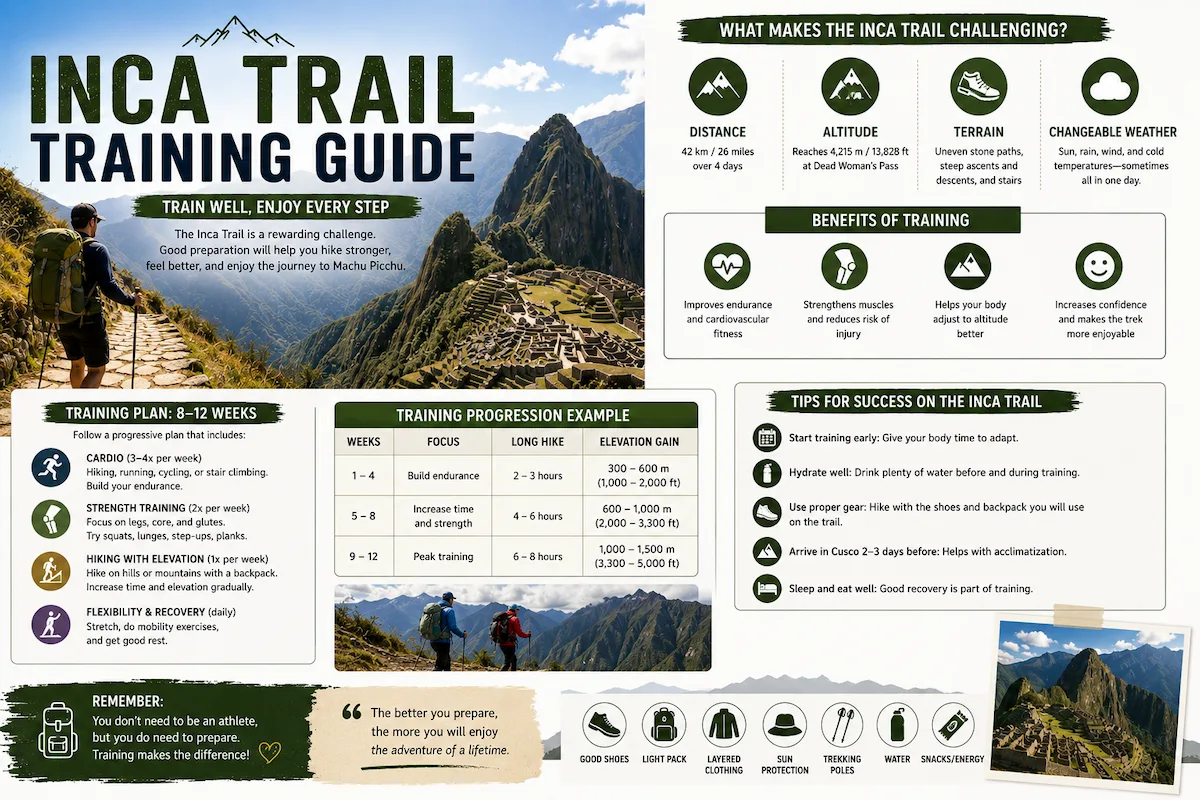
You do not need to be an athlete to hike the Inca Trail, but arriving physically prepared can make a major difference.

The Classic Inca Trail involves four days of hiking, long uphill sections, steep stone steps, sustained descents, uneven terrain, and elevations above 4,000 meters.

Your training should therefore focus on more than simply walking long distances.

By: Jhoel
Inca Trail Training Guide How to Prepare for the Trek

Table Of Content

You need to prepare your:

  • Cardiovascular endurance

  • Leg strength

  • Core stability

  • Balance

  • Uphill hiking ability

  • Downhill control

  • Ability to walk on consecutive days

For most travelers, starting structured training around 8 weeks before the trek provides enough time to gradually improve fitness without trying to do too much at once.

If you currently exercise very little, starting earlier can make the progression easier.

How Fit Do You Need to Be for the Inca Trail?

You should be comfortable walking for several hours and climbing hills or stairs without becoming completely exhausted.

You do not need:

  • Technical climbing experience

  • Mountaineering skills

  • Marathon-level fitness

  • Advanced hiking experience

But you should arrive with enough endurance to handle several consecutive days of physical activity.

The Classic route is generally considered moderate to challenging because of its combination of altitude, climbs, descents, and stone staircases.

Read our complete guide to Inca Trail difficulty if you want to understand what makes the trek physically demanding.

How Long Should You Train for the Inca Trail?

Around 8 weeks of focused preparation is a useful starting point for someone who already has a basic level of fitness.

If you rarely exercise, consider beginning 10 to 12 weeks before your trip.

If you already hike, run, cycle, or train several times per week, you may need less adaptation.

Your current fitness matters more than following an exact number of weeks.

Current FitnessSuggested Preparation
Mostly inactive10–12+ weeks
Occasionally active8–10 weeks
Regularly active6–8 weeks
Regular hikerMaintain fitness and add trail-specific training

The goal is gradual improvement.

Do not suddenly begin long hikes or intense workouts shortly before traveling.

What Should Inca Trail Training Focus On?

A good training program should combine four main areas.

Cardiovascular Endurance

Your heart and lungs need to support several hours of walking.

Useful activities include:

  • Brisk walking

  • Hiking

  • Running

  • Cycling

  • Swimming

  • Stair climbing

  • Incline treadmill walking

You do not need to run if you dislike running.

Walking uphill consistently is one of the most relevant forms of preparation because it resembles what you will actually do on the trail.

Leg Strength

Your legs do most of the work.

Focus particularly on:

  • Quadriceps

  • Hamstrings

  • Glutes

  • Calves

These muscles help you climb mountain passes and control your body during long descents.

Core Strength

Your core helps stabilize your body when walking over uneven terrain and carrying a daypack.

You do not need complicated exercises.

Simple exercises such as planks and controlled bodyweight movements can help build stability.

Balance and Stability

The Inca Trail is not a smooth path.

You will walk over stone steps, uneven surfaces, and changing terrain.

Exercises that improve single-leg balance and stability can help you move more confidently.

Best Exercises for Inca Trail Training

You do not need specialized gym equipment.

Several simple exercises directly support the movements you will use while hiking.

Squats

Squats strengthen your quadriceps, glutes, and hips.

These muscles work constantly during uphill hiking.

Start with bodyweight squats and gradually add resistance if appropriate for your fitness level.

Lunges

Lunges help develop leg strength and stability.

Try:

  • Forward lunges

  • Reverse lunges

  • Walking lunges

Controlled movement is more important than speed.

Step-Ups

Step-ups are one of the most useful exercises for preparing for the Inca Trail.

They imitate the repeated movement of climbing stone stairs.

Use a stable step or platform.

As you improve, you can gradually increase repetitions or practice while wearing your hiking daypack.

Step-Downs

Do not train only for climbing.

The Inca Trail also contains long descents.

Controlled step-down exercises help strengthen the muscles used to slow your body while descending.

Move slowly rather than dropping quickly onto the lower foot.

Calf Raises

Your calves work constantly during uphill hiking.

Calf raises are simple and can be performed almost anywhere.

Planks

Planks help strengthen your core.

A stronger core improves stability while carrying a backpack and moving over uneven terrain.

Stair Climbing

If you do not live near mountains, stairs are one of your best alternatives.

Use:

  • Building stairs

  • Stadium stairs

  • Stair-climbing machines

  • Steep urban streets

Gradually increase the amount of climbing instead of starting with extremely long sessions.

Do You Need to Run to Train for the Inca Trail?

No.

Running can improve cardiovascular fitness, but it is not required.

If you enjoy running, include it.

If you do not, you can build endurance through:

  • Brisk walking

  • Hiking

  • Cycling

  • Swimming

  • Incline treadmill sessions

  • Stair climbing

Training should be sustainable.

An activity you perform consistently is more useful than a demanding routine you abandon after two weeks.

Train for Uphill Hiking

Uphill walking should be a major part of your preparation.

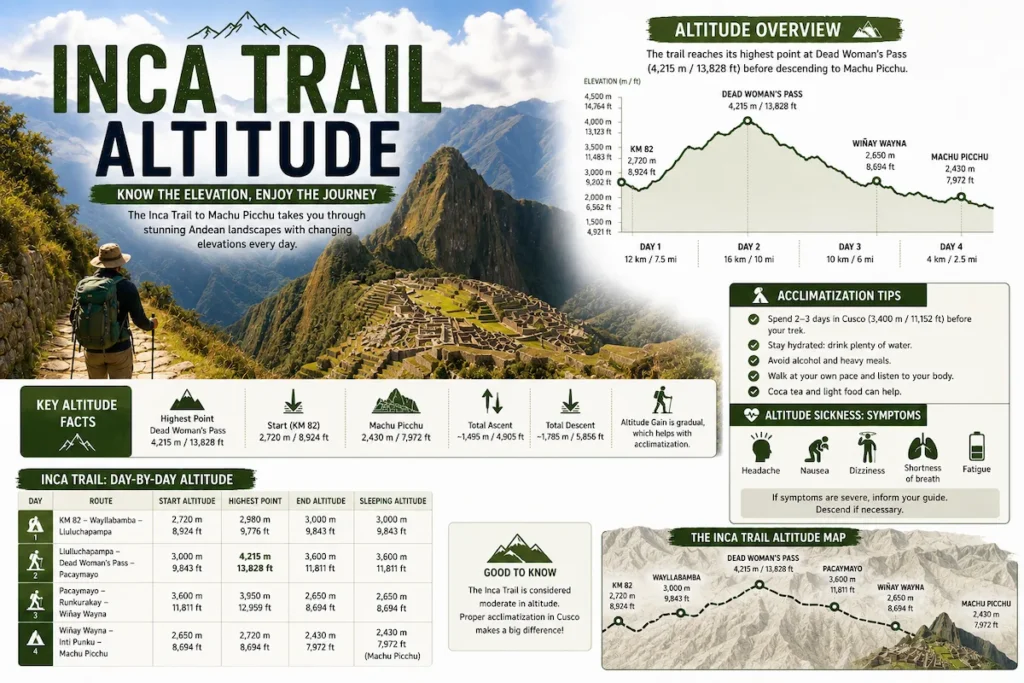
The climb toward Dead Woman’s Pass is one of the most demanding sections of the Classic route.

The pass reaches approximately 4,215 meters (13,829 ft) above sea level.

You should therefore become comfortable maintaining a slow, consistent effort uphill.

If you have access to hills, gradually increase:

  • Distance

  • Elevation gain

  • Walking time

  • Number of climbs

If you live somewhere flat, use stairs or an incline treadmill.

Learn more about the elevations you will encounter in our Inca Trail altitude guide.

Train for Downhill Hiking Too

This is one of the most overlooked parts of Inca Trail preparation.

Many travelers train extensively for climbing but do little preparation for descending.

The Inca Trail contains long sections of stone steps.

Downhill walking repeatedly loads your quadriceps and can become tiring for your knees and legs.

During training, include:

  • Downhill hikes

  • Controlled step-downs

  • Walking lunges

  • Stair descents

  • Leg-strength exercises

Do not rush downhill during practice.

Focus on controlled movement.

Practice Hiking on Uneven Terrain

A treadmill can improve endurance, but it cannot completely reproduce a mountain trail.

Whenever possible, train outdoors.

Look for routes with:

  • Hills

  • Stairs

  • Rocks

  • Uneven surfaces

  • Ascents and descents

This helps develop balance and teaches your feet and ankles to adjust to changing terrain.

Your longest training sessions should ideally include terrain rather than only flat pavement.

Train With Your Daypack

You will carry a small backpack during the trek.

Do some of your training walks with the same backpack you plan to use in Peru.

Start light.

Gradually add the items you would normally carry, such as:

  • Water

  • Rain jacket

  • Extra layer

  • Snacks

  • Personal items

The purpose is not to carry the heaviest backpack possible.

You want your shoulders, back, and legs to become accustomed to your realistic trail load.

Our Inca Trail packing list will help you decide what you actually need to carry.

Break In Your Hiking Shoes Before the Trek

Do not save new hiking shoes for Peru.

Wear them during your training.

Your longer walks are a good opportunity to test:

  • Comfort

  • Fit

  • Socks

  • Grip

  • Pressure points

  • Blister problems

By the time you begin the Inca Trail, your footwear should already feel familiar.

You should also know which socks work best for longer hiking days.

Practice Consecutive Hiking Days

The Classic Inca Trail is not difficult only because of individual hiking days.

The accumulated fatigue matters.

You walk, rest overnight, and then hike again the following morning.

As your trek approaches, include occasional back-to-back training days.

For example:

Saturday: Longer hike

Sunday: Moderate walk or hike

You do not need to exhaust yourself.

The objective is to experience walking when your legs are not completely fresh.

8-Week Inca Trail Training Plan

This example can be adjusted according to your current fitness.

Weeks 1–2: Build a Base

Focus on consistency.

3 days per week: cardio

30–45 minutes of:

  • Brisk walking

  • Cycling

  • Running

  • Swimming

  • Incline treadmill

2 days per week: strength

Include:

  • Squats

  • Lunges

  • Step-ups

  • Calf raises

  • Planks

1 longer walk

Aim for approximately 60–90 minutes at a comfortable pace.

The objective during these first weeks is simply to establish a routine.

Weeks 3–4: Add Hills and Stairs

Begin making your workouts more specific to hiking.

3 cardio sessions

Approximately 40–60 minutes.

Include hills or incline whenever possible.

2 strength sessions

Continue focusing on legs and core.

Add controlled step-downs.

1 longer hike

Try to include elevation changes.

Begin using your hiking footwear regularly.

Weeks 5–6: Increase Hiking Time

Your training should now resemble trekking more closely.

2–3 cardio sessions

Use a mixture of:

  • Hills

  • Stairs

  • Incline walking

  • Cycling

  • Running

2 strength sessions

Continue:

  • Squats

  • Lunges

  • Step-ups

  • Step-downs

  • Calf raises

  • Core exercises

1 long hike

Gradually increase your hiking duration.

Wear your daypack.

Include both climbs and descents.

Week 7: Trail-Specific Training

This can be one of your strongest training weeks.

Complete:

  • 2 cardiovascular sessions

  • 2 strength sessions

  • 1 long hike

  • 1 easier hike or long walk

If possible, complete your longer hike with similar footwear and backpack weight to what you will use in Peru.

You should finish tired but not completely exhausted.

Week 8: Reduce Training

Do not try to gain extra fitness at the last minute.

Reduce your training volume before traveling.

Continue light movement, walking, and mobility work, but allow your body to recover.

Arriving rested is more useful than completing an extremely hard workout immediately before your trip.

Example Weekly Training Schedule

A typical week during the middle of your training period could look like this:

DayTraining
MondayRest
Tuesday45–60 min cardio + hills
WednesdayLeg and core strength
Thursday45–60 min cardio
FridayRest or easy walking
SaturdayLong hike with elevation
SundayStrength or moderate walk

This is only an example.

Your schedule should match your fitness, available time, and recovery needs.

How Long Should Your Training Hikes Be?

You do not need to complete a four-day trek before coming to Peru.

Instead, gradually build your ability to stay active for longer periods.

Start with shorter hikes and increase the duration over several weeks.

Closer to your trip, completing a few hikes lasting several hours can help you understand how your body responds to sustained walking.

Your longer hikes should include elevation whenever possible.

Should You Train at High Altitude?

Training at altitude can be useful if you live near mountains, but it is not required.

Most travelers cannot reproduce Inca Trail elevations at home.

Do not worry if you train at sea level.

Focus on building:

  • Cardiovascular fitness

  • Leg strength

  • Hiking endurance

  • Balance

  • Comfortable pacing

Altitude acclimatization happens when you arrive in Peru.

Fitness training and acclimatization are not the same thing.

Fitness Does Not Prevent Altitude Sickness

This is important.

Excellent physical fitness does not guarantee that you will adapt quickly to high altitude.

The Inca Trail reaches approximately 4,215 meters at Dead Woman’s Pass.

Your body needs time to adjust to reduced oxygen availability.

Even experienced athletes can experience altitude symptoms.

This is why your training plan should be combined with proper acclimatization.

Read our Inca Trail altitude guide before deciding how many days to spend in the Cusco region before the trek.

How Many Days Should You Spend in Cusco Before the Inca Trail?

Many travelers allow at least a few days in the Cusco region before beginning the trek.

Use this time to acclimatize rather than trying to continue intensive training.

Light walking can be useful, but you do not need to complete difficult hikes immediately before departure.

Your hardest training should already be finished.

Our guide on how to plan the Inca Trail to Machu Picchu explains how to include acclimatization within your Peru itinerary.

Should You Train With Trekking Poles?

If you plan to use trekking poles on the trail, practice with them before traveling.

Poles can feel awkward when you first use them.

Training allows you to learn:

  • Pole length

  • Hand position

  • Uphill technique

  • Downhill technique

  • Rhythm

They can be particularly useful for maintaining stability during descents.

What If You Only Have 4 Weeks to Train?

Four weeks is not ideal if you are starting from a very low fitness level, but you can still improve your preparation.

Focus on the activities most relevant to hiking.

Week 1

  • 3 cardio sessions

  • 2 strength sessions

  • 1 longer walk

Week 2

Add hills or stairs.

Complete one longer hike if possible.

Week 3

Increase hiking duration and practice with your daypack.

Include both climbs and descents.

Week 4

Reduce intensity before traveling.

Do not try to compensate for limited preparation by completing extremely intense workouts during your final days.

Common Inca Trail Training Mistakes

Training Only on Flat Ground

Flat walking helps endurance but does not adequately prepare your legs for mountain passes and stairs.

Add hills or stairs.

Ignoring Descents

Training only for uphill sections leaves your legs unprepared for long downhill sections.

Practice controlled descents.

Carrying Too Much Weight

There is no benefit in making every training hike unnecessarily difficult.

Practice with approximately the load you expect to carry during the trek.

Wearing New Shoes on the Trail

Test your footwear during training.

Do not discover fit problems during Day 1 of the trek.

Training Hard Until Departure

Your body needs recovery.

Reduce your workload before traveling.

Assuming Fitness Solves Altitude

It does not.

Training improves your physical ability to hike.

Acclimatization helps your body adapt to altitude.

You need both.

Inca Trail Fitness Checklist

Before your trip, you should ideally feel comfortable with:

  • Walking for several hours

  • Hiking uphill for sustained periods

  • Climbing stairs without excessive fatigue

  • Walking downhill comfortably

  • Hiking on uneven terrain

  • Carrying your daypack

  • Using your hiking footwear for long walks

  • Exercising on consecutive days

  • Maintaining a slow and steady pace uphill

You do not need to complete these activities faster than everyone else.

Consistency matters more than speed.

Can Beginners Train for the Inca Trail?

Yes.

The Inca Trail can be a realistic goal for first-time trekkers who give themselves enough time to prepare.

If you are a beginner, start slowly.

Build endurance first, then gradually introduce hills, stairs, longer hikes, and your daypack.

Avoid comparing your training with experienced runners or hikers.

Your goal is to prepare your body for your trek.

Is Training Different for the Short Inca Trail?

Yes.

The Short Inca Trail requires less preparation than the four-day Classic route because you avoid several days of consecutive trekking and the highest mountain passes.

However, you still need to climb uphill and navigate stone steps.

Basic cardiovascular fitness and leg strength remain useful.

If you are deciding between the routes based on your physical condition, compare the Short Inca Trail vs Classic Inca Trail.

Training vs Acclimatization

These are two separate parts of preparation.

TrainingAcclimatization
Done before PeruMainly happens after reaching altitude
Builds enduranceHelps your body adjust to elevation
Strengthens musclesImproves adaptation to reduced oxygen
Prepares you for climbsHelps you function at high altitude
Can take several weeksRequires time at elevation

You cannot replace acclimatization with additional gym sessions.

Likewise, spending several days in Cusco does not replace physical preparation.

Both matter.

Prepare for the Trail, Not for Speed

Your training goal is not to hike the Inca Trail as quickly as possible.

You want to arrive capable of walking steadily for several hours, recovering overnight, and doing it again the next day.

Focus on endurance, hills, stairs, leg strength, controlled descents, and real hiking whenever possible.

Combine that preparation with enough time to acclimatize after arriving in Peru.

Once your training is underway, use our Inca Trail packing list to prepare your equipment and read the complete Inca Trail to Machu Picchu guide to understand the route you are training for.